What is PolicyGlass?�
PolicyGlass is an effective permission parser for AWS Policies. It takes normal JSON policies of any type
(Principal, Resource, or Endpoint) and converts them into PolicyShard objects
that are always assertions about what is allowed.
Use Cases�
There are two main use cases for this tool:
Writing tools that audit the permissions provided to AWS resources/principals
Validating your understanding of the complex policy you’re writing.
Why do I need PolicyGlass?�
Isn’t this a simple problem? I can just check actions and resources in each statement, boom, done.
Understanding AWS policies programmatically is harder than it looks.
You can write code easily enough to check what resources and actions are in each statement,
and that might seem like enough. But what happens when you throw a Deny statement into the mix?
Well that’s okay, you just check each statement to see if it’s an allow or a deny and if it’s a deny
then you just remove any resources from the allow that exist in the deny right?
Easy enough, but what about resources that are just * or are ARNs with wildcards in them?
Once you’ve got past that, you have to deal with statements that contain negations
(NotAction, NotResource, and NotPrincipal), it’s starting to get harder.
Then you have to add in the complexity of conditions, and all this is without even mentioning the complexity
of parsing an AWS Policy in the first place with the variants of Actions as a list or as a string, or
Resources that may be a string or a dictionary.
PolicyGlass takes care of all this for you by breaking down a policy into its components and applying set operations in order to build shards that describe the effective permissions.
Examples of PolicyShards�
Below you can find some examples on how PolicyGlass can be used to understand complex policies in a consistent way.
We’re going to use policy_shards_to_json() to make the output a bit easier to read.
Tip
Remember PolicyShard objects are not policies.
They represent policies in an abstracted way that makes them easier to understand programmatically, the JSON output
you see in the examples is not a policy you can use directly in AWS.
Simple�
>>> from policyglass import Policy, dedupe_policy_shards, policy_shards_effect, policy_shards_to_json
>>> policy_a = Policy(**{
...     "Version": "2012-10-17",
...     "Statement": [
...         {
...             "Effect": "Allow",
...             "Action": [
...                 "s3:*"
...             ],
...             "Resource": "*"
...         }
...     ]
... })
>>> policy_b = Policy(**{
...     "Version": "2012-10-17",
...     "Statement": [
...         {
...             "Effect": "Deny",
...             "Action": [
...                 "s3:*"
...             ],
...             "Resource": "arn:aws:s3:::examplebucket/*"
...         }
...     ]
... })
>>> policy_shards = policy_shards_effect([*policy_a.policy_shards, *policy_b.policy_shards])
>>> print(policy_shards_to_json(policy_shards, exclude_defaults=True, indent=2))
[
   {
     "effective_action": {
       "inclusion": "s3:*"
     },
     "effective_resource": {
       "inclusion": "*",
       "exclusions": [
         "arn:aws:s3:::examplebucket/*"
       ]
     },
     "effective_principal": {
       "inclusion": {
         "type": "AWS",
         "value": "*"
       }
     }
   }
 ]
- PolicyShard #1 (first dictonary in list) tells us:
s3:* is allowed for all resources except
arn:aws:s3:::examplebucket/*
- What occurred:
The
resourcefrom the deny was added to the allow’sEffectiveResource’sexclusions
De-duplicate�
>>> from policyglass import Policy, dedupe_policy_shards, policy_shards_to_json
>>> policy_a = Policy(**{
...     "Version": "2012-10-17",
...     "Statement": [
...         {
...             "Effect": "Allow",
...             "Action": [
...                 "s3:*"
...             ],
...             "Resource": "*"
...         }
...     ]
... })
>>> policy_b = Policy(**{
...     "Version": "2012-10-17",
...     "Statement": [
...         {
...             "Effect": "Allow",
...             "Action": [
...                 "s3:*"
...             ],
...             "Resource": "*"
...         }
...     ]
... })
>>> policy_shards = dedupe_policy_shards([*policy_a.policy_shards, *policy_b.policy_shards])
>>> print(policy_shards_to_json(policy_shards, exclude_defaults=True, indent=2))
[
   {
     "effective_action": {
       "inclusion": "s3:*"
     },
     "effective_resource": {
       "inclusion": "*"
     },
     "effective_principal": {
       "inclusion": {
         "type": "AWS",
         "value": "*"
       }
     }
   }
 ]
- PolicyShard #1 (first dictonary in list) tells us:
s3:*is allowed on all resources.
- What occurred:
One of the two
s3:*policy shards was removed because it was a duplicate.
Deny Not Resource Policy�
>>> from policyglass import Policy, policy_shards_effect, policy_shards_to_json
>>> policy_a = Policy(**{
...     "Version": "2012-10-17",
...     "Statement": [
...         {
...             "Effect": "Allow",
...             "Action": [
...                 "s3:*",
...                 "s3:GetObject"
...             ],
...             "Resource": "*"
...         },
...         {
...             "Effect": "Deny",
...             "Action": [
...                 "s3:*",
...             ],
...             "NotResource": "arn:aws:s3:::examplebucket/*",
...             "Condition": {
...                  "StringNotEquals": {
...                      "s3:x-amz-server-side-encryption": "AES256"
...                  }
...             }
...         }
...     ]
... })
>>> shards_effect = policy_shards_effect(policy_a.policy_shards)
>>> print(policy_shards_to_json(shards_effect, exclude_defaults=True, indent=2))
[
   {
     "effective_action": {
       "inclusion": "s3:*"
     },
     "effective_resource": {
       "inclusion": "arn:aws:s3:::examplebucket/*"
     },
     "effective_principal": {
       "inclusion": {
         "type": "AWS",
         "value": "*"
       }
     }
   },
   {
     "effective_action": {
       "inclusion": "s3:*"
     },
     "effective_resource": {
       "inclusion": "*",
       "exclusions": [
         "arn:aws:s3:::examplebucket/*"
       ]
     },
     "effective_principal": {
       "inclusion": {
         "type": "AWS",
         "value": "*"
       }
     },
     "effective_condition": {
       "inclusions": [
         {
           "key": "s3:x-amz-server-side-encryption",
           "operator": "StringEquals",
           "values": [
             "AES256"
           ]
         }
       ]
     }
   }
 ]
The output has two policy shards.
- PolicyShard #1 (first dictionary in list) tells us:
Allow
s3:*On
arn:aws:s3:::examplebucket/*No conditions
- PolicyShard #2 (second dictionary in list) tells us:
Allow
s3:*On all resources
If the condition applies.
- What occurred:
s3:GetObjectwas removed from the allow because it was totally withins3:*A new
PolicyShardwas created withs3:*The deny’s
conditiongot reversed fromStringNotEqualstoStringEqualsand added to the new allowPolicyShard.
Examples of Policy Analysis�
Example Policy�
Let’s use a complex IAM policy as our example to demonstrate the value in analyzing policies with PolicyGlass.
>>> from policyglass import Policy
>>> test_policy = Policy(**{
...   "Version": "2012-10-17",
...   "Statement": [
...     {
...       "Effect": "Allow",
...       "Action": [
...         "s3:*"
...       ],
...       "Resource": "*",
...       "Condition": {
...         "NumericLessThan": {
...             "s3:TlsVersion": 1.2
...         }
...       }
...     },
...     {
...       "Effect": "Allow",
...       "Action": [
...         "s3:*"
...       ],
...       "Resource": "arn:aws:s3:::examplebucket/*"
...     },
...     {
...       "Effect": "Deny",
...       "Action": [
...         "s3:PutObject"
...       ],
...       "NotResource": "arn:aws:s3:::examplebucket/*",
...       "Condition": {
...         "StringNotEquals": {
...           "s3:x-amz-server-side-encryption": "AES256"
...         }
...       }
...     }
...   ]
... })
Understanding a Policy�
To understand the policy, let’s get the policy_shards_effect() then use the explain_policy_shards() method to explain them.
>>> from policyglass import policy_shards_effect, explain_policy_shards
>>> test_policy_shards = policy_shards_effect(test_policy.policy_shards)
>>> explain_policy_shards(test_policy_shards)
["Allow action s3:PutObject on resource * (except for arn:aws:s3:::examplebucket/*) with principal AWS *.
    Provided conditions s3:TlsVersion NumericLessThan ['1.2'] and s3:x-amz-server-side-encryption StringEquals ['AES256'] are met.",
"Allow action s3:* (except for s3:PutObject) on resource * (except for arn:aws:s3:::examplebucket/*) with principal AWS *.
    Provided conditions s3:TlsVersion NumericLessThan ['1.2'] are met.",
'Allow action s3:* on resource arn:aws:s3:::examplebucket/* with principal AWS *.']
That helps clarify what the policy results in for humans. But what if we want to programatically ask a question about what this allows?
Interrogating a Policy�
- Question:
Is
s3:PutObjectallowed onarn:aws:s3:::some-other-bucket/*?
To answer this we need to check 2 things:
Is
s3:PutObjectallowed on the shard?If so, is
resource arn:aws:s3:::examplebucket/*allowed on the same shard?
As we have multiple (3) shards we have to make sure both of the answers are true for the same shard.
We can do this with a list comprehension and utilise the in operator to check that the
EffectiveAction contains s3:PutObject and that the
EffectiveResource contains arn:aws:s3:::some-other-bucket/*.
>>> from policyglass import Action, Resource
>>> action = Action('s3:PutObject')
>>> resource = Resource('arn:aws:s3:::some-other-bucket/*')
>>> result = [
...     shard
...     for shard in test_policy_shards
...     if action in shard.effective_action
...     and resource in shard.effective_resource
... ]
>>> result
[PolicyShard(effect='Allow',
    effective_action=EffectiveAction(inclusion=Action('s3:PutObject'), exclusions=frozenset()),
    effective_resource=EffectiveResource(inclusion=Resource('*'), exclusions=frozenset({Resource('arn:aws:s3:::examplebucket/*')})),
    effective_principal=EffectivePrincipal(inclusion=Principal(type='AWS', value='*'), exclusions=frozenset()),
    effective_condition=EffectiveCondition(inclusions=frozenset({Condition(key='s3:x-amz-server-side-encryption', operator='StringEquals', values=['AES256']),
            Condition(key='s3:TlsVersion', operator='NumericLessThan', values=['1.2'])}),
        exclusions=frozenset()))]
From this check we can see that it is allowed by at least one shard! But there are two conditions.
Checking if Conditions exist�
Whether we want to check these conditions depends on what kind of question we want to ask. Either way it’s trivial to check if a condition exists or not.
>>> bool(result[0].effective_condition)
True
Class Reference�
Policy�
Core Policy class.
- class Policy(*, Version=None, Statement)�
Main policy class.
Example
Create a policy from a dictionary.
>>> from policyglass import Policy
>>> Policy(**{
...     "Version": "2012-10-17",
...     "Statement": [
...         {
...             "Effect": "Allow",
...             "Action": [
...                 "s3:*"
...             ],
...             "Resource": "*"
...         }
...     ]
... })
Policy(version='2012-10-17',
    statement=[Statement(effect='Allow',
        action=[Action('s3:*')],
        not_action=None,
        resource=[Resource('*')],
        not_resource=None, principal=None,
        not_principal=None,
        condition=None)])
- Parameters
Version (str) –
Statement (List[policyglass.statement.Statement]) –
- Return type
- property policy_shards: List[policyglass.policy_shard.PolicyShard]�
Shatter this policy into a number
policyglass.policy_shardobjects.
- statement: List[policyglass.statement.Statement]�
Policy Shard�
PolicyShards are a simplified representation of policies.
- class PolicyShard(effect, effective_action, effective_resource, effective_principal, effective_condition=None)�
A PolicyShard is part of a policy broken down in such a way that it can be deduplicated and collapsed.
- Parameters
effect (str) –
effective_action (policyglass.effective_arp.EffectiveARP[policyglass.action.Action]) –
effective_resource (policyglass.effective_arp.EffectiveARP[policyglass.resource.Resource]) –
effective_principal (policyglass.effective_arp.EffectiveARP[policyglass.principal.Principal]) –
effective_condition (policyglass.condition.EffectiveCondition) –
- Return type
- class Config�
Pydantic Config.
- json_encoders = {<class 'policyglass.action.EffectiveAction'>: <function PolicyShard.Config.<lambda>>, <class 'policyglass.resource.EffectiveResource'>: <function PolicyShard.Config.<lambda>>, <class 'policyglass.principal.EffectivePrincipal'>: <function PolicyShard.Config.<lambda>>}�
- __init__(effect, effective_action, effective_resource, effective_principal, effective_condition=None)�
Initialize a PolicyShard object.
- Parameters
effect (str) – ‘Allow’ or ‘Deny’
effective_action (policyglass.effective_arp.EffectiveARP[policyglass.action.Action]) – The EffectiveAction that this PolicyShard allows or denies
effective_resource (policyglass.effective_arp.EffectiveARP[policyglass.resource.Resource]) – The EffectiveResource that this PolicyShard allows or denies
effective_principal (policyglass.effective_arp.EffectiveARP[policyglass.principal.Principal]) – The EffectivePrincipal that this PolicyShard allows or denies
effective_condition (Optional[policyglass.condition.EffectiveCondition]) – The EffectiveCondition that needs to be met for this PolicyShard to apply
- Return type
- dict(*args, **kwargs)�
Convert instance to dict representation of it.
- Parameters
*args – Arguments to Pydantic dict method.
**kwargs – Arguments to Pydantic dict method.
- Return type
Dict[str, Any]
Overridden from BaseModel so that when converting conditions to dict they don’t suffer from being unhashable when placed in a set.
- difference(other, dedupe_result=True)�
Calculate the difference between this and another object of the same type.
Effectively subtracts the inclusions of
otherfromself. This is useful when applying denies (other) to allows (self).- Parameters
- Raises
ValueError – If
otheris not the same type as this object.- Return type
- effective_action: policyglass.effective_arp.EffectiveARP[policyglass.action.Action]�
- effective_condition: policyglass.condition.EffectiveCondition�
- effective_principal: policyglass.effective_arp.EffectiveARP[policyglass.principal.Principal]�
- effective_resource: policyglass.effective_arp.EffectiveARP[policyglass.resource.Resource]�
- property explain: str�
Return a plain English representation of the policy shard.
Example
Simple PolicyShard explain.
>>> from policyglass import Policy
>>> policy = Policy(**{"Statement": [{"Effect": "Allow", "Action": "s3:*"}]})
>>> print([shard.explain for shard in policy.policy_shards])
['Allow action s3:* on resource * with principal AWS *.']
- intersection(other)�
Calculate the intersection between this object and another object of the same type.
- Parameters
other (object) – The object to intersect with this one.
- Raises
ValueError – if
otheris not the same type as this object.- Return type
Optional[policyglass.policy_shard.PolicyShard]
- issubset(other)�
Whether this object contains all the elements of another object (i.e. is a subset of the other object).
- Conditions:
If both PolicyShards have conditions but are otherwise identical, self will be a subset of other if the other’s conditions are are a subset of self’s as this means that self is more restrictive and therefore carves out a subset of possiblilites in comparison with other.
- Parameters
other (object) – The object to determine if our object contains.
- Raises
ValueError – If the other object is not of the same type as this object.
- Return type
- union(other)�
Combine this object with another object of the same type.
- Parameters
other (object) – The object to combine with this one.
- Raises
ValueError – If
otheris not the same type as this object.- Return type
- dedupe_policy_shard_subsets(shards, check_reverse=True)�
Dedupe policy shards that are subsets of each other.
- Parameters
shards (Iterable[policyglass.policy_shard.PolicyShard]) – The shards to deduplicate.
check_reverse (bool) – Whether you want to check these shards in reverse as well (only disabled when alling itself).
- Return type
- dedupe_policy_shards(shards, check_reverse=True)�
Dedupe policy shards that are subsets of each other and remove intersections.
- Parameters
shards (Iterable[policyglass.policy_shard.PolicyShard]) – The shards to deduplicate.
check_reverse (bool) – Whether you want to check these shards in reverse as well (only disabled when calling itself).
- Return type
- explain_policy_shards(shards, language='en')�
Return a list of string explanations for a given list of PolicyShards.
Example
How to get the effective permissions of a policy as a plain English explanation.
>>> from policyglass import Policy, policy_shards_effect, explain_policy_shards
>>> policy = Policy(
...     **{
...         "Version": "2012-10-17",
...         "Statement": [
...             {
...                 "Effect": "Allow",
...                 "Action": ["s3:*"],
...                 "Resource": "*",
...             },
...             {
...                 "Effect": "Deny",
...                 "Action": ["s3:Get*"],
...                 "Resource": "*",
...             },
...         ],
...     }
... )
>>> explain_policy_shards(policy_shards_effect(policy.policy_shards))
['Allow action s3:* (except for s3:Get*) on resource * with principal AWS *.']
- Parameters
shards (List[policyglass.policy_shard.PolicyShard]) – The PolicyShards to explain.
language (str) – The language of the explanation
- Raises
NotImplementedError – When an unsupported language is requested.
- Return type
List[str]
- policy_shards_effect(shards)�
Calculate the effect of merging allow and deny shards together.
Example
How to get the effective permissions of a policy as
PolicyShardobjects.>>> from policyglass import Policy, policy_shards_effect, explain_policy_shards >>> policy = Policy( ... **{ ... "Version": "2012-10-17", ... "Statement": [ ... { ... "Effect": "Allow", ... "Action": ["s3:*"], ... "Resource": "*", ... }, ... { ... "Effect": "Deny", ... "Action": ["s3:Get*"], ... "Resource": "*", ... }, ... ], ... } ... ) >>> policy_shards = policy.policy_shards >>> policy_shards_effect(policy_shards) [PolicyShard(effect='Allow', effective_action=EffectiveAction(inclusion=Action('s3:*'), exclusions=frozenset({Action('s3:Get*')})), effective_resource=EffectiveResource(inclusion=Resource('*'), exclusions=frozenset()), effective_principal=EffectivePrincipal(inclusion=Principal(type='AWS', value='*'), exclusions=frozenset()), effective_condition=EffectiveCondition(inclusions=frozenset(), exclusions=frozenset()))]
- Parameters
shards (List[policyglass.policy_shard.PolicyShard]) – The shards to caclulate the effect of.
- Return type
- policy_shards_to_json(shards, exclude_defaults=False, **kwargs)�
Convert a list of
PolicyShardobjects to JSON.Example
How to get the effective permissions of a policy as json.
>>> from policyglass import Policy, policy_shards_effect, policy_shards_to_json
>>> policy = Policy(
...     **{
...         "Version": "2012-10-17",
...         "Statement": [
...             {
...                 "Effect": "Allow",
...                 "Action": ["s3:*"],
...                 "Resource": "*",
...             },
...             {
...                 "Effect": "Deny",
...                 "Action": ["s3:Get*"],
...                 "Resource": "*",
...             },
...         ],
...     }
... )
>>> policy_shards = policy.policy_shards
>>> output = policy_shards_to_json(
...     policy_shards_effect(policy_shards),
...     indent=2,
...     exclude_defaults=True
... )
>>> print(output)
[
    {
        "effective_action": {
            "inclusion": "s3:*",
            "exclusions": [
                "s3:Get*"
            ]
        },
        "effective_resource": {
            "inclusion": "*"
        },
        "effective_principal": {
            "inclusion": {
                "type": "AWS",
                "value": "*"
            }
        }
    }
]
- Parameters
shards (List[policyglass.policy_shard.PolicyShard]) – The list of shards to convert.
exclude_defaults – Whether to exclude default values (e.g. empty lists) from the output.
**kwargs – keyword arguments passed on to
json.dumps()
- Return type
Statement�
Statement class.
- class Effect�
Allow or Deny.
- class Statement(*, Effect, Action=None, NotAction=None, Resource=None, NotResource=None, Principal=None, NotPrincipal=None, Condition=None)�
A Policy Statement.
- Parameters
Effect (policyglass.statement.Effect) –
Action (List[policyglass.action.Action]) –
NotAction (List[policyglass.action.Action]) –
Resource (List[policyglass.resource.Resource]) –
NotResource (List[policyglass.resource.Resource]) –
Principal (policyglass.principal.PrincipalCollection) –
NotPrincipal (policyglass.principal.PrincipalCollection) –
Condition (policyglass.condition.RawConditionCollection) –
- Return type
- class Config�
Configure the Pydantic BaseModel.
- action: Optional[List[policyglass.action.Action]]�
- condition: Optional[policyglass.condition.RawConditionCollection]�
- effect: policyglass.statement.Effect�
- classmethod ensure_action_list(v)�
- Parameters
v (policyglass.statement.T) –
- Return type
- classmethod ensure_condition_value_list(v)�
- Parameters
v (Dict[policyglass.condition.ConditionKey, Dict[policyglass.condition.ConditionOperator, Union[policyglass.condition.ConditionValue, List[policyglass.condition.ConditionValue]]]]) –
- Return type
- classmethod ensure_principal_dict(v)�
- Parameters
v (Union[policyglass.principal.PrincipalValue, Dict[policyglass.principal.PrincipalType, Union[policyglass.principal.PrincipalValue, List[policyglass.principal.PrincipalValue]]]]) –
- Return type
- classmethod ensure_resource_list(v)�
- Parameters
v (policyglass.statement.T) –
- Return type
- not_action: Optional[List[policyglass.action.Action]]�
- not_principal: Optional[policyglass.principal.PrincipalCollection]�
- not_resource: Optional[List[policyglass.resource.Resource]]�
- property policy_shards: List[policyglass.policy_shard.PolicyShard]�
- principal: Optional[policyglass.principal.PrincipalCollection]�
- resource: Optional[List[policyglass.resource.Resource]]�
Action�
Action class.
- class Action�
Actions are case insensitive.
“The prefix and the action name are case insensitive�
- issubset(other)�
Whether this object contains all the elements of another object (i.e. is a subset of the other object).
- Parameters
other (object) – The object to determine if our object contains.
- Raises
ValueError – If the other object is not of the same type as this object.
- Return type
- class EffectiveAction(inclusion, exclusions=None)�
EffectiveActions are the representation of the difference between an Action and its exclusion.
The allowed actions is the difference (subtraction) of the excluded Actions from the included action.
- exclusions: FrozenSet[policyglass.effective_arp.T]�
Exclusions must always be a subset of the include and must not be subsets of each other
- inclusion: policyglass.effective_arp.T�
Inclusion must be a superset of any exclusions
Resource�
Resource class.
- class EffectiveResource(inclusion, exclusions=None)�
EffectiveResources are the representation of the difference between an Resource and its exclusion.
The allowed Resource is the difference (subtraction) of the excluded Resources from the included Resource.
- exclusions: FrozenSet[policyglass.effective_arp.T]�
Exclusions must always be a subset of the include and must not be subsets of each other
- inclusion: policyglass.effective_arp.T�
Inclusion must be a superset of any exclusions
- class Resource�
A resource ARN may be case sensitive or case insensitive depending on the resource type.
- issubset(other)�
Whether this object contains all the elements of another object (i.e. is a subset of the other object).
- Parameters
other (object) – The object to determine if our object contains.
- Raises
ValueError – If the other object is not of the same type as this object.
- Return type
Principal�
Principal classes.
- class EffectivePrincipal(inclusion, exclusions=None)�
EffectivePrincipals are the representation of the difference between an Principal and its exclusion.
The allowed Principal is the difference (subtraction) of the excluded Principals from the included Principal.
- exclusions: FrozenSet[policyglass.effective_arp.T]�
Exclusions must always be a subset of the include and must not be subsets of each other
- inclusion: policyglass.effective_arp.T�
Inclusion must be a superset of any exclusions
- class Principal(type, value)�
A class which represents a single Principal including its type.
Objects of this type are typically generated by the
Statementclass.- Parameters
type (policyglass.principal.PrincipalType) –
value (policyglass.principal.PrincipalValue) –
- Return type
- __init__(type, value)�
Create a new model by parsing and validating input data from keyword arguments.
Raises ValidationError if the input data cannot be parsed to form a valid model.
- Parameters
type (policyglass.principal.PrincipalType) –
value (policyglass.principal.PrincipalValue) –
- Return type
- issubset(other)�
Whether this object contains all the elements of another object (i.e. is a subset of the other object).
- Parameters
other (object) – The object to determine if our object contains.
- Raises
ValueError – If the other object is not of the same type as this object.
- Return type
- type: policyglass.principal.PrincipalType�
Principal Type
- value: policyglass.principal.PrincipalValue�
Principal value
- class PrincipalCollection�
A collection of Principals of different types, unique to PolicyGlass.
- property principals: List[policyglass.principal.Principal]�
- class PrincipalType�
A principal type, e.g. Federated or AWS.
See AWS JSON policy elements: Principal for more.
- class PrincipalValue�
An ARN, wildcard, or other appropriate value of a policy Principal.
See AWS JSON policy elements: Principal for more.
Condition�
Statement Condition classes.
- class Condition(key, operator, values)�
A representation of part of a statement condition in order to facilitate comparison.
- Parameters
key (policyglass.condition.ConditionKey) –
operator (policyglass.condition.ConditionOperator) –
values (List[policyglass.condition.ConditionValue]) –
- Return type
- __init__(key, operator, values)�
Create a new model by parsing and validating input data from keyword arguments.
Raises ValidationError if the input data cannot be parsed to form a valid model.
- Parameters
key (policyglass.condition.ConditionKey) –
operator (policyglass.condition.ConditionOperator) –
values (List[policyglass.condition.ConditionValue]) –
- Return type
- classmethod factory(condition_collection)�
- Parameters
condition_collection (policyglass.condition.RawConditionCollection) –
- Return type
FrozenSet[policyglass.condition.Condition]
- property reverse: policyglass.condition.Condition�
Return a new condition which is the opposite of this condition.
- Raises
ValueError – If the operator is a type that cannot be reversed.
- values: List[policyglass.condition.ConditionValue]�
- class ConditionKey�
Condition Keys are case insensitive.
“Condition key names are not case-sensitive.� - IAM Reference Policy Elements
- class ConditionOperator�
Condition Operator.
See IAM JSON policy elements: Condition operators for more.
- class ConditionValue�
Condition values may or may not be case sensitive depending on the operator.
- class EffectiveCondition(inclusions=None, exclusions=None)�
A pair of sets for inclusions and exclusion conditions.
- Parameters
inclusions (FrozenSet[policyglass.condition.Condition]) –
exclusions (FrozenSet[policyglass.condition.Condition]) –
- Return type
- __init__(inclusions=None, exclusions=None)�
Convert
exclusionstoinclusionsif possible.The only type of Condition that really exists in AWS policies is the
inclusions. Theexclusionsare created only when conditions on aDenystatement have operators that cannot be reversed. The reversal is required in order to fold a Deny condition into an Allow condition.- Parameters
inclusions (Optional[FrozenSet[policyglass.condition.Condition]]) – The conditions that must be met.
exclusions (Optional[FrozenSet[policyglass.condition.Condition]]) – The conditions that must NOT be met.
- Return type
- dict(*args, **kwargs)�
Convert instance to dict representation of it.
- Parameters
*args – Arguments to Pydantic dict method.
**kwargs – Arguments to Pydantic dict method.
- Return type
Dict[str, Any]
Overridden from BaseModel so that when converting conditions to dict they don’t suffer from being unhashable when placed in a set.
- exclusions: FrozenSet[policyglass.condition.Condition]�
Conditions which must NOT be met
- inclusions: FrozenSet[policyglass.condition.Condition]�
Conditions which must be met
- intersection(other)�
Calculate the intersection between this object and another object of the same type.
- Parameters
other (object) – The object to intersect with this one.
- Raises
ValueError – if
otheris not the same type as this object.- Return type
- property reverse: policyglass.condition.EffectiveCondition�
Reverse the effect of this EffectiveCondition.
- union(other)�
Combine this object with another object of the same type.
- Parameters
other (object) – The object to combine with this one.
- Raises
ValueError – If
otheris not the same type as this object.- Return type
- OPERATOR_REVERSAL_INDEX = {ConditionOperator('ArnEquals'): ConditionOperator('ArnNotEquals'), ConditionOperator('ArnEqualsIfExists'): ConditionOperator('ArnNotEqualsIfExists'), ConditionOperator('ArnLike'): ConditionOperator('ArnNotLike'), ConditionOperator('ArnLikeIfExists'): ConditionOperator('ArnNotLikeIfExists'), ConditionOperator('ArnNotEquals'): ConditionOperator('ArnEquals'), ConditionOperator('ArnNotEqualsIfExists'): ConditionOperator('ArnEqualsIfExists'), ConditionOperator('ArnNotLike'): ConditionOperator('ArnLike'), ConditionOperator('ArnNotLikeIfExists'): ConditionOperator('ArnLikeIfExists'), ConditionOperator('DateEquals'): ConditionOperator('DateNotEquals'), ConditionOperator('DateEqualsIfExists'): ConditionOperator('DateNotEqualsIfExists'), ConditionOperator('DateGreaterThan'): ConditionOperator('DateLessThanEquals'), ConditionOperator('DateGreaterThanEquals'): ConditionOperator('DateLessThan'), ConditionOperator('DateGreaterThanEqualsIfExists'): ConditionOperator('DateLessThanIfExists'), ConditionOperator('DateGreaterThanIfExists'): ConditionOperator('DateLessThanEqualsIfExists'), ConditionOperator('DateLessThan'): ConditionOperator('DateGreaterThanEquals'), ConditionOperator('DateLessThanEquals'): ConditionOperator('DateGreaterThan'), ConditionOperator('DateLessThanEqualsIfExists'): ConditionOperator('DateGreaterThanIfExists'), ConditionOperator('DateLessThanIfExists'): ConditionOperator('DateGreaterThanEqualsIfExists'), ConditionOperator('DateNotEquals'): ConditionOperator('DateEquals'), ConditionOperator('DateNotEqualsIfExists'): ConditionOperator('DateEqualsIfExists'), ConditionOperator('IpAddress'): ConditionOperator('NotIpAddress'), ConditionOperator('IpAddressIfExists'): ConditionOperator('NotIpAddressIfExists'), ConditionOperator('NotIpAddress'): ConditionOperator('IpAddress'), ConditionOperator('NotIpAddressIfExists'): ConditionOperator('IpAddressIfExists'), ConditionOperator('NumericEquals'): ConditionOperator('NumericNotEquals'), ConditionOperator('NumericEqualsIfExists'): ConditionOperator('NumericNotEqualsIfExists'), ConditionOperator('NumericGreaterThan'): ConditionOperator('NumericLessThanEquals'), ConditionOperator('NumericGreaterThanEquals'): ConditionOperator('NumericLessThan'), ConditionOperator('NumericGreaterThanEqualsIfExists'): ConditionOperator('NumericLessThanIfExists'), ConditionOperator('NumericGreaterThanIfExists'): ConditionOperator('NumericLessThanEqualsIfExists'), ConditionOperator('NumericLessThan'): ConditionOperator('NumericGreaterThanEquals'), ConditionOperator('NumericLessThanEquals'): ConditionOperator('NumericGreaterThan'), ConditionOperator('NumericLessThanEqualsIfExists'): ConditionOperator('NumericGreaterThanIfExists'), ConditionOperator('NumericLessThanIfExists'): ConditionOperator('NumericGreaterThanEqualsIfExists'), ConditionOperator('NumericNotEquals'): ConditionOperator('NumericEquals'), ConditionOperator('NumericNotEqualsIfExists'): ConditionOperator('NumericEqualsIfExists'), ConditionOperator('StringEquals'): ConditionOperator('StringNotEquals'), ConditionOperator('StringEqualsIfExists'): ConditionOperator('StringNotEqualsIfExists'), ConditionOperator('StringEqualsIgnoreCase'): ConditionOperator('StringNotEqualsIgnoreCase'), ConditionOperator('StringEqualsIgnoreCaseIfExists'): ConditionOperator('StringNotEqualsIgnoreCaseIfExists'), ConditionOperator('StringLike'): ConditionOperator('StringNotLike'), ConditionOperator('StringLikeIfExists'): ConditionOperator('StringNotLikeIfExists'), ConditionOperator('StringNotEquals'): ConditionOperator('StringEquals'), ConditionOperator('StringNotEqualsIfExists'): ConditionOperator('StringEqualsIfExists'), ConditionOperator('StringNotEqualsIgnoreCase'): ConditionOperator('StringEqualsIgnoreCase'), ConditionOperator('StringNotEqualsIgnoreCaseIfExists'): ConditionOperator('StringEqualsIgnoreCaseIfExists'), ConditionOperator('StringNotLike'): ConditionOperator('StringLike'), ConditionOperator('StringNotLikeIfExists'): ConditionOperator('StringLikeIfExists')}�
A list of operators and their opposite.
- class RawConditionCollection�
A representation of a statement condition.
- property conditions: FrozenSet[policyglass.condition.Condition]�
Return a list of Condition Shards.
Understanding Effective Conditions�
Policy conditions, when they exist, are always restrictions on the scenarios in which a policy applies.
Every PolicyShard object will have a EffectiveCondition
object, even if the EffectiveCondition has no inclusions or exclusions specified.
What is an inclusion/exclusion?�
An EffectiveCondition inclusion is a Condition which
must be true, for a PolicyShard to apply.
An EffectiveCondition exclusion is a Condition which
must be false, for a PolicyShard to apply.
>>> from policyglass import PolicyShard, EffectiveAction, Action, EffectiveResource, Resource, EffectivePrincipal, Principal, EffectiveCondition, Condition
>>> effective_condition = EffectiveCondition(
...     inclusions=frozenset({
...         Condition("aws:PrincipalOrgId", "StringEquals", ["o-123456"]),
...     }),
...     exclusions=frozenset({
...         Condition(key="TestKey", operator="BinaryEquals", values=["QmluYXJ5VmFsdWVJbkJhc2U2NA=="])
...    }),
... )
>>> policy_shard = PolicyShard(
...     effect="Allow",
...     effective_action=EffectiveAction(Action("*")),
...     effective_resource=EffectiveResource(Resource("*")),
...     effective_principal=EffectivePrincipal(Principal("AWS", "*")),
...     effective_condition=effective_condition
... )
This effective_condition’s inclusions dictate that for Action, Resource and Principal to be allowed, then at the time the API call takes place the
following be true:
aws:PrincipalOrgIdmustStringEqualsa value ofo-123456.TestKeymust NOTBinaryEqualsa value ofQmluYXJ5VmFsdWVJbkJhc2U2NA==
When would an exclusion occur?�
An EffectiveCondition exclusion is quite a rare phenomenon.
Normally when Deny PolicyShard conditions are folded into
Allow PolicyShard objects, they are reversed using the
reverse attribute.
For example StringNotEquals on a Deny PolicyShard will become StringEquals on an Allow PolicyShard.
This simplifies the intelligibility of the Allow shards significantly.
When a Deny statement has a condition that cannot be reversed (e.g. BinaryEquals for which there is no corresponding BinaryNotEquals)
then the condition must be placed into the exclusions of the effective_condition of the Allow PolicyShard.
Understanding Effective Actions�
In PolicyGlass we express ARPs (Action Resource policyglass.principal.Principal) as though they are potentially
infinite sets.
In reality they are finite sets because there are only a finite number of allowed actions, resources, or principals. However because actions are being constantly updated by AWS, and new resources and princiapls are being created all the time, we here treat them as infinite sets because their extent is unknowable by us when we are parsing the policy.
Components of an EffectiveAction�
An EffectiveAction object has two components:
The inclusions indicate the Action that this effective action applies to
and the exclusions indicate the actions that this effective action does not apply to.
At its simplest an effective action is just an inclusion, which you can think of as a Venn diagram
containing S3:*.

EffectiveAction without exclusion�
Then if you have an exclusion of S3:Get* you can think of this as a hole punched in the Venn diagram.

EffectiveAction with exclusion�
The area in the middle indicating that S3:Get* is not included in the effective action.
Difference�
The difference between set x and set y is the elements that are contained in set x that are not contained in set y. In essence it’s a subtraction. Remove the elements in set y from set x and you have the difference.
Simple�
Let’s say we calculate the difference between two effective actions like so.
>>> from policyglass import EffectiveAction, Action
>>> x = EffectiveAction(inclusion=Action("S3:*"))
>>> y = EffectiveAction(inclusion=Action("S3:Get*"))
>>> x.difference(y)
[EffectiveAction(inclusion=Action('S3:*'), exclusions=frozenset({Action('S3:Get*')}))]
The result is that the inclusion from y is added to the exclusions of x.
Simple Difference�
S3:*is theinclusionfromxS3:Get*is theinclusionfromy
The inclusion from x is added as an exclusion of y is because our Actions are essentially infinite sets. The wildcard at the end of S3:*
could extend to an infinitely long string for all we know, so we can’t create an Action that
expresses S3:* but not S3:Get* so we must add it as an exclusion in an EffectiveAction.
This is the reason EffectiveAction s exist, so we can express the
intersection of the complement of ininite set B with inifite set A.
Complex�
Let’s say we have two effective actions we want to diff.
One is just S3:* and the other is S3:Get* except for S3:GetObject.
To diff these we want to subtract S3:Get* from S3:* but leave S3:GetObject in place.
>>> from policyglass import EffectiveAction, Action
>>> x = EffectiveAction(inclusion=Action("S3:*"))
>>> y = EffectiveAction(inclusion=Action("S3:Get*"), exclusions=frozenset({Action("S3:GetObject")}))
>>> print(x.difference(y))
[EffectiveAction(inclusion=Action('S3:*'), exclusions=frozenset({Action('S3:Get*')})),
 EffectiveAction(inclusion=Action('S3:GetObject'), exclusions=frozenset())]
Let’s unpack what happened here.
We added the inclusion (
S3:get*) from y to the exclusions of xWe returned a new effective action that is just
S3:GetObject

Complex Difference (theoretical)�
S3:*is ourinclusionfromxS3:Get*is ourinclusionfromyS3:GetObjectis ourexclusionfromy
In the above Venn diagram we’re showing that the difference between the two effective actions is
to include S3:* except S3:Get* but still include S3:GetObject.
We can’t have an inclusion inside an exclusion so we represent this by adding another effective action object
to represent the inclusion.

Complex Difference (actual output)�
Outputting two effective actions makes a list of PolicyShard objects
much easier to understand because you will end up with two shards (one for each effective action) rather
than one super hard to understand shard that has an action inclusion inside an action exclusion inside an
action inclusion.
Remember that the exclusions in an EffectiveAction are negations, they are holes punched in what’s allowed. As a result, what is in the exclusion of y should not be removed from x because it’s explicitly not part of y.
Because we can’t express the fact that we want to exclude B and C but include A in our result, we have to return
two separate EffectiveAction s, one which includes A but the entirety of B, and another that just includes D.
Understanding Policy Shards�
Dedupe & Merge�
PolicyShard objects need to go through two phases to correct their sizes.
Dedupe using
dedupe_policy_shard_subsets()Merge using
dedupe_policy_shards()
The first collapses all PolicyShards which are subsets of each other into each other, in other words eliminating all smaller PolicyShards that can fit into bigger PolicyShards.
The second reverses that where necessary, identifying shards that are not subsets of each other but nonetheless have some intersection and therefore duplicate the permissions space.
When does a PolicyShard intesect without being a subset?�
This is a departure from EffectiveARPs (Action, Resource, Principal) objects which by contrast cannot intersect without being subsets.
Let’s consider this scenario
>>> from policyglass import PolicyShard
>>> from policyglass.action import Action, EffectiveAction
>>> from policyglass.condition import Condition, EffectiveCondition
>>> from policyglass.principal import EffectivePrincipal, Principal
>>> from policyglass.resource import EffectiveResource, Resource
>>> shard_a = PolicyShard(
...     effect="Allow",
...     effective_action=EffectiveAction(inclusion=Action("s3:*"), exclusions=frozenset({Action("s3:PutObject")})),
...     effective_resource=EffectiveResource(inclusion=Resource("*")),
...     effective_principal=EffectivePrincipal(inclusion=Principal(type="AWS", value="*")),
...     effective_condition=EffectiveCondition(frozenset(
...         {Condition(key="aws:PrincipalOrgId", operator="StringNotEquals", values=["o-123456"])}
...     )),
... )
>>> shard_b = PolicyShard(
...     effect="Allow",
...     effective_action=EffectiveAction(inclusion=Action("s3:*")),
...     effective_resource=EffectiveResource(inclusion=Resource("*")),
...     effective_principal=EffectivePrincipal(inclusion=Principal(type="AWS", value="*")),
...     effective_condition=EffectiveCondition(frozenset(
...         {
...             Condition(key="aws:PrincipalOrgId", operator="StringNotEquals", values=["o-123456"]),
...             Condition(key="s3:x-amz-server-side-encryption", operator="StringEquals", values=["AES256"]),
...         }
...     )),
... )
- Shard A
Has a single condition
Excludes
s3:PutObject
- Shard B
Has two conditions, one of which is the same as Shard A
Does not exclude
s3:PutObject
This means that.
Because Shard A and Shard B both have conditions they can never be considered subsets of one another even during the decomposition process
They do intersect because every part of
s3:*apart froms3:PutObjectis less restrictively allowed by Shard AWe want to reduce the scope of Shard B to just
s3:PutObject
To do this we use dedupe_policy_shards()
>>> from policyglass.policy_shard import dedupe_policy_shards
>>> shard_b_delineated, shard_a_delineated = dedupe_policy_shards([shard_a, shard_b])
>>> assert shard_a_delineated == PolicyShard(
...     effect='Allow',
...     effective_action=EffectiveAction(inclusion=Action('s3:*'), exclusions=frozenset({Action('s3:PutObject')})),
...     effective_resource=EffectiveResource(inclusion=Resource('*')),
...     effective_principal=EffectivePrincipal(inclusion=Principal(type='AWS', value='*')),
...     effective_condition=EffectiveCondition(frozenset(
...         {Condition(key='aws:PrincipalOrgId', operator='StringNotEquals', values=['o-123456'])}
...     )),
... )
>>> assert shard_b_delineated == PolicyShard(
...    effect='Allow',
...    effective_action=EffectiveAction(inclusion=Action('s3:PutObject')),
...    effective_resource=EffectiveResource(inclusion=Resource('*')),
...    effective_principal=EffectivePrincipal(inclusion=Principal(type='AWS', value='*')),
...    effective_condition=EffectiveCondition(frozenset({
...        Condition(key='aws:PrincipalOrgId', operator='StringNotEquals', values=['o-123456']),
...        Condition(key='s3:x-amz-server-side-encryption', operator='StringEquals', values=['AES256'])
...    })),
... )
You’ll notice that the intersection has been removed, as Shard B now only has s3:PutObject as the rest of s3:* was covered by Shard A.
PolicyGlass�



PolicyGlass allows you to analyse one or more AWS policies’ effective permissions in aggregate, by restating them in the form of PolicyShards which are always Allow, never Deny.
PolicyGlass will always result in only allow PolicyShard objects, no matter how complex the policy. This makes understanding the effect of your policies programmatically a breeze.
Try it out�
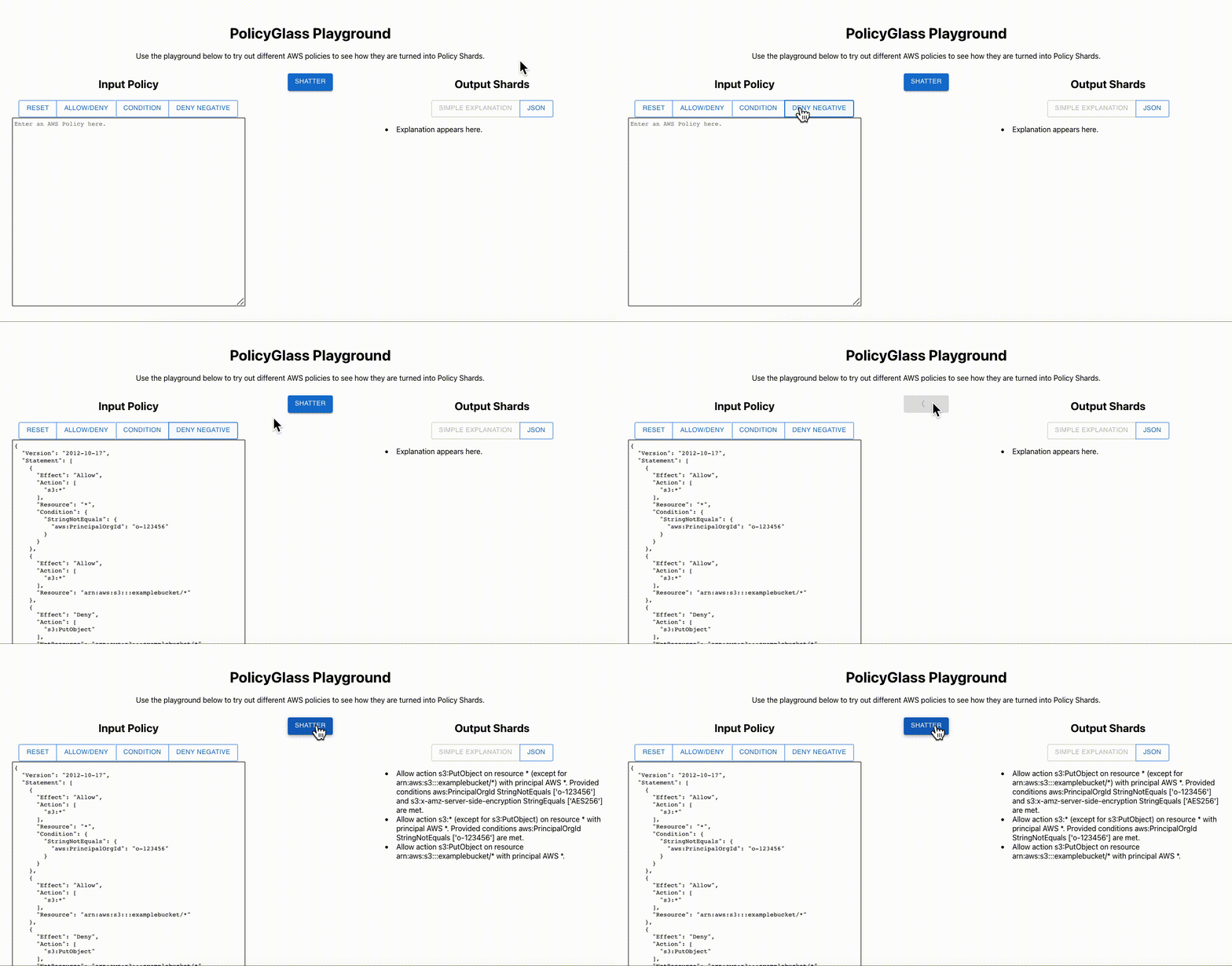
Try out custom policies quickly without installing anything with the PolicyGlass Sandbox.
Installation�
pip install policyglass
Usage�
Let’s take two policies, a and b and pit them against each other.
>>> from policyglass import Policy, policy_shards_effect
>>> policy_a = Policy(**{
...     "Version": "2012-10-17",
...     "Statement": [
...         {
...             "Effect": "Allow",
...             "Action": [
...                 "s3:*"
...             ],
...             "Resource": "*"
...         }
...     ]
... })
>>> policy_b = Policy(**{
...     "Version": "2012-10-17",
...     "Statement": [
...         {
...             "Effect": "Deny",
...             "Action": [
...                 "s3:*"
...             ],
...             "Resource": "arn:aws:s3:::examplebucket/*"
...         }
...     ]
... })
>>> policy_shards = [*policy_a.policy_shards, *policy_b.policy_shards]
>>> effect = policy_shards_effect(policy_shards)
>>> effect
[PolicyShard(effect='Allow',
   effective_action=EffectiveAction(inclusion=Action('s3:*'),
      exclusions=frozenset()),
   effective_resource=EffectiveResource(inclusion=Resource('*'),
      exclusions=frozenset({Resource('arn:aws:s3:::examplebucket/*')})),
   effective_principal=EffectivePrincipal(inclusion=Principal(type='AWS', value='*'),
      exclusions=frozenset()),
   effective_condition=EffectiveCondition(inclusions=frozenset(), exclusions=frozenset()))]
Two policies, two statements, resulting in a single allow PolicyShard.
More complex policies will result in multiple shards, but they will always be allows, no matter how complex the policy.
You can also make them human readable!
>>> from policyglass import explain_policy_shards
>>> explain_policy_shards(effect)
['Allow action s3:* on resource * (except for arn:aws:s3:::examplebucket/*) with principal AWS *.']